header shadow

Bacteriology

Topics of Interest

Quick Links


Susceptiblity Profiles

Fee Schedule

User Guide


Dr. Tim Frana -
Section Leader


Kris Clothier

Dr. Kris Clothier

Staff

Joann Kinyon
Sylvia Carter
David Frisk
Susan Fulster
Tim Klinefelter
Leona McDeid
Dee Murphy
Nadine Naberhaus
Linda Terry
Curt Thompson


Milk Quality

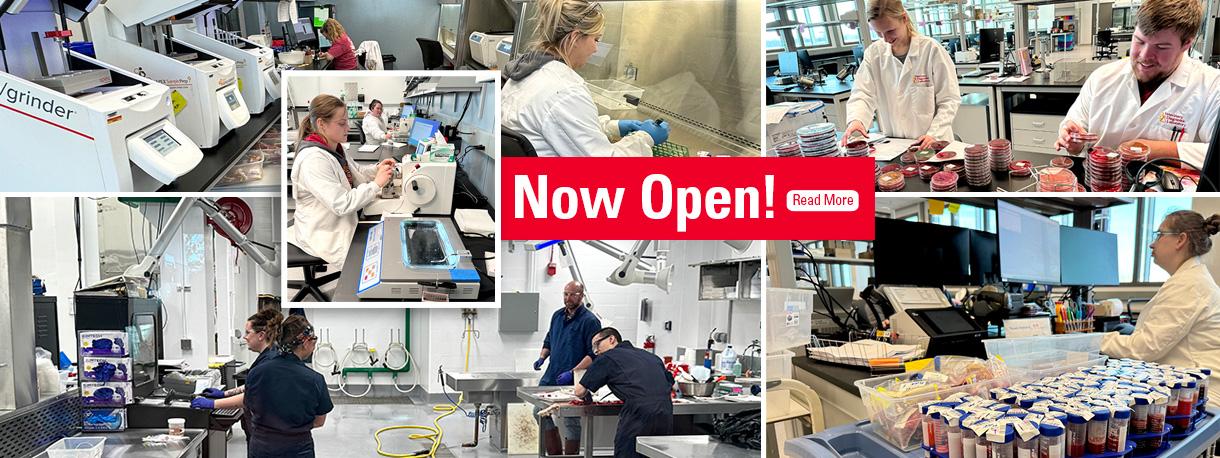
Renovated facilities accommodate
processing large volumes of samples.

The value of milk quality testing is becoming clear to Iowa dairy producers and milk quality specialists at ISU VDPAM are available to help troubleshoot milking equipment and cleaning problems.  The ISU VDL Bacteriology Section focuses on rapid testing turnaround and processed over 5,000 samples during the first 6 months of 2008 including following milk culture testing options:

  • Basic Milk Culture designed to isolate & identify aerobic contagious pathogens (Staph aureus & Strep ag.) and genus identification of environmental organisms. Testing may also include Mycoplasma spp. culture.
  • Aerobic culture results available in 48 hours.
  • Bulk tank cultures with or without Mycoplasma spp. culture.
  • Standard plate count, preliminary incubation, lab pasteurized
  • count, and coliform count testing.
  • Bedding & environmental culturing.

    Dr. Pat Gorden    


Contact Dr. Patrick Gorden, in the Dairy Section of Food Supply Veterinary Medicine (FSVM) 515-294-3096 or Joann Kinyon
(515-294-9411) for more information.

Renovated facilities accommodate processing large volumes of samples. Milk quality specialists are available to help you troubleshoot your client’s milking equipment and cleaning problems.

Clients utilizing Dairy Comp 305 can create electronic submission files resulting in increased accuracy and efficiency. When test results are complete, they can be downloaded to a computer to assist with herd management in addition to currently available reports.


Direct Fecal PCR Mycobacterium paratuberculosis

The Iowa State University Veterinary Diagnostic Laboratory is now offering qualitative direct fecal PCR testing for the detection of Mycobacterium avium var paratuberculosis DNA in bovine feces.  Results are available in 3-5 days compared with the eight weeks required for liquid fecal culture testing. Sensitivity for the direct PCR is comparable to the culture system for high- and moderate-shedding animals. The test is also highly specific for detecting MAP DNA and is able to discriminate between Mycobacterium avium var paratuberculosis and other fecal Mycobacteria species. 

Collect feces directly from the rectum if possible. Place at least 2 grams (1 tablespoon) into sterile plastic container. Use permanent marker to label vial with animal ID. Submit cooled samples to the ISU VDL as soon as possible. Do not freeze. Cost of the test is $30 per sample. For more information, contact Dr. Kris Clothier at 515-294-1950.

Back to the top


Moraxella bovoculi 

Moraxella bovoculi is a recently described novel Moraxella species that in one study has been the only bacterial isolate obtained from approximately one-half of the IBK affected corneas of cattle in California. (Angelos JA, et al. Int J Syst Evol Microbiol 2007;57:789) Cultures obtained from the ocular surface of both normal and IBK affected cattle located here in the Midwest have confirmed the presence of this organism. At the present time, no successful attempts to fulfill Koch's postulates with this species have been documented and its role in the pathophysiology of IBK remains unclear.  Reevaluation of previous ocular cultures has revealed that many of the isolates previously classified as M. ovis (formerly Branhamella ovis) are actually M. bovoculi, however M. ovis does still remain a distinct species and may occasionally be isolated from the ocular surface of cattle. 

Currently the ISU VDL is using biochemical tests to differentiate M. bovoculi from M. ovis.  A small number of isolates for which biochemical tests were unable to appropriately speciate the isolates have been reported in the literature.  Thus, when differentiation of M. ovis and M. bovoculi is critical, confirmatory molecular differentiation of these isolates may be warranted.  Clients will note the classification of the Moraxellae to Moraxella bovis, Moraxella ovis and/or Moraxella bovoculi in our reporting in future cases of IBK.  At this time, the identification at ISU VDL does not include PCR testing, but the isolates can be forwarded for PCR testing at other facilities.  Please address questions regarding this organism to Dr. Annette O'Connor (515-294-5012), Dr. Paul Plummer (515-294-8522), Dr. Vickie Cooper (515-294-1950) or Joann Kinyon (515-294-1950). 


Real-time PCR test for Mycoplasma bovis   

The Iowa State Veterinary Diagnostic Laboratory is now offering a new diagnostic test (real-time PCR) to detect the genetic material of Mycoplasma bovis.  Preferred samples are milk, bulk tank milk, lung, tracheal wash, bronchoalveolar lavage, joint and ear fluid, tonsil swabs and nasal swabs (as a last resort in the diagnosis of M. bovis disease). The regular testing days will be Monday and Thursday. Please contact the diagnostic laboratory for submission practices and samples for the most economical testing. When submitting samples that do not require histopathology, please be sure to clearly specify the PCR test.


Mycoplasma hyosynoviae and Mycoplasma hyorhinis

Mycoplasma hyosynoviae is common in swine herds and can be found in the nasal and pharyngeal secretions and lungs of healthy pigs. Stress or other predisposing factors can lead to systemic spread resulting in arthritis in pigs between the ages of 12-24 weeks with a morbidity of 1-50% within affected herds.
The optimal sample to submit is joint fluid. Joint swabs or joint tissue such as synovium are also acceptable. Samples should be transported chilled on ice but not frozen.

Mycoplasma hyorhinis is ubiquitous in swine herds and can be found in the lungs and nasal secretions of healthy pigs. But predisposing factors such as concurrent disease or stress can lead to septicemic spread resulting arthritis and serofibrinous to fibrinopurulent polyserositis. M. hyorhinis most commonly affects pigs between the ages of 3-10 weeks, but occasionally can affect young-adult swine.

Samples to submit from arthritis cases may be joint fluid (preferred), a joint swab or joint tissue. Polyserositis cases should submit serous exudates, swab or fibrin tag. Samples should be transported chilled on ice, but not frozen.

For more information, please contact Dr. Erin Strait at 515-294-1950, estrait@iastate.edu.


Back to the top